
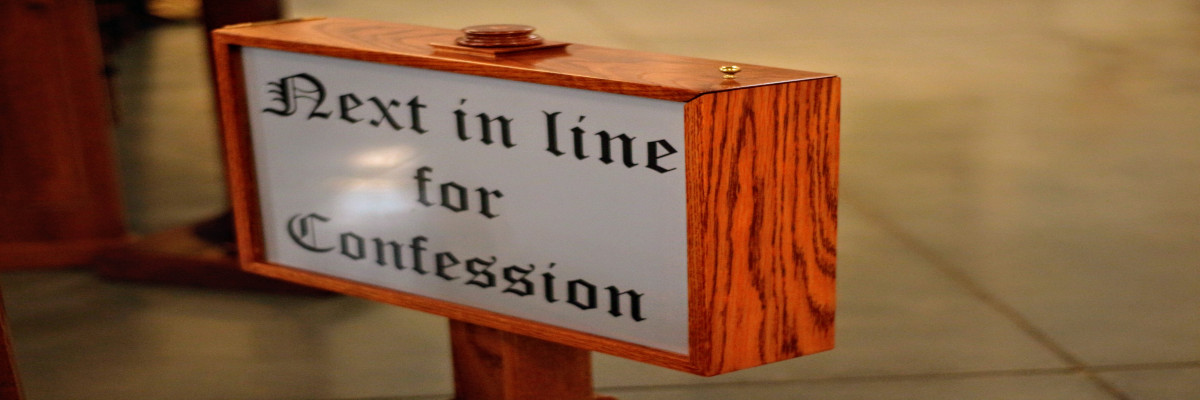
"Jesus began his risen life by giving the apostles power to forgive sins. the sacrament of Reconciliation continues His work of forgiving and reconciling. It celebrates the prodigal's return to the eternally merciful Father, renewing the sinner's union with God and also, with the community, in as much as, our sins harm our brothers and sisters." -National Directory for Catechesis
The sacrament of Reconciliation is offered on Saturdays at 9:00 AM.
Special Communal Reconciliation Services are held during Advent and Lent.
About the Sacrament of Penance and Reconciliation (Confession)
How to go to Confession
Wanting to go to confession is the first step in going to confession. Confessing your sins wipes the slate clean again with God and makes us stronger spiritually. Regularly going to confession is a way to grow in holiness. Knowing what to do in confession will make the process much easier.
Much of the work for a good celebration of a sacrament takes place prior to arriving at church. An honest, humble, and thorough examination of conscience helps you to prepare for the sacrament. Writing your sins on a piece of paper before you go can help you during your confession.
Once you arrive at church, take a few minutes to pray, asking the Holy Spirit to help you make a good confession. When it is your turn, enter the reconciliation room. You can either kneel behind a screen or sit in a chair facing the priest.
In the Confessional
- The priest will welcome you.
- Begin by making the Sign of the Cross.
- A simple formula can get you going: “Forgive me, Father, for I have sinned. My last confession was ___ days/months/years ago and these are my sins.”
- You then list the kind and number of your sins (e.g. I missed Mass 3 times; I lied 20 times).
- The priest may ask you questions and/or offer you counsel.
- The priest will give you an appropriate penance (e.g. “For your penance, please pray 2 Hail Marys).
- The priest then invites you (the penitent) to make an Act of Contrition. There are no required words, although you need to include that you are sorry and that you will amend your life. A commonly used Act of Contrition is the following:
"My God, I am sorry for my sins with all my heart. In choosing to do wrong and failing to good, I have sinned against You, whom I should love above all things. I firmly intend, with the help of Your grace, to sin no more and to avoid whatever leads me to sin. Our Savior, Jesus Christ, suffered and died for us. In His name, my God, have mercy." - The priest then prays the prayer of absolution (forgiveness): "God the Father of mercies, through the death and resurrection of His Son, has reconciled the world to Himself and sent the Holy Spirit among us for the forgiveness of sins. Through the ministry of the Church, may God grant you pardon and peace. I absolve you from your sins, in the name of the Father, and of the Son and of the Holy Spirit."
- You answer, “Amen.”
- The priest may then say, “God has forgiven your sins. Go in peace.”
- You respond, “Thanks be to God.”
- You then leave and as soon as possible complete the penance the priest has assigned to you.
Confession is one part of the sacrament of Penance & Reconciliation; completing your penance is the other part. Believe it or not, going to confession is the easy part. The hard part is actually amending our life so that we do not commit these sins again. For this, we need God’s abundant grace through the Eucharist, prayer, fasting, and alms-giving.
By Andres Ortiz
To learn more about confession, click here