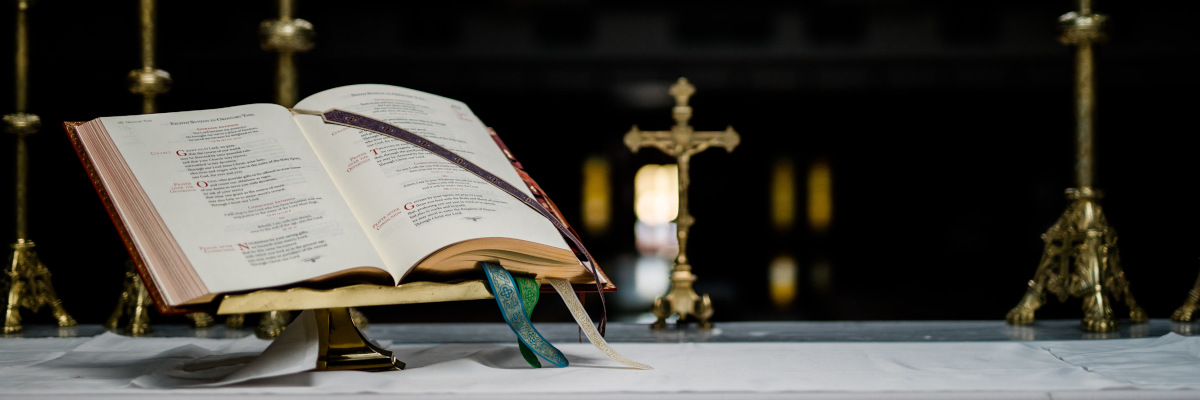
“The Blessed Eucharist is the perfect Sacrament of the Lord's Passion, since it contains Christ Himself and His Passion." -St. Thomas Aquinas
Click here for our Mass schedule!
First Eucharist
Children:
Formulario de Inscripción para el Sacramento
Sacrament Preparation Information
Información de Preparación para el Sacramento
2026-2027 Religious Education Calendar
Calendario de Educación Religiosa para el 2026-2027
Please download and save the above Sacrament Registration Fillable Form as a PDF, open and fill it in, then save and send it as an email attachment to Mrs. Marjorie Lamb at This email address is being protected from spambots. You need JavaScript enabled to view it.. You may also print it, fill it in by hand, and send a photocopy to Mrs. Marjorie Lamb.
To make a payment use this link: Sacrament Preparation Fee - Enlace de pago
Thank you.
--------------
No one knows your child better than you. Beginning at the age of 7, which typically coincides with 2nd grade, a child becomes eligible to prepare for and receive the sacraments of Reconciliation and first Holy Communion. This does not mean, however, that every 2nd grade child is ready to prepare for and receive Holy Communion. As the parent, it is your right and responsibility to discern with your child whether he or she is ready to to begin preparation for Holy Communion by considering the following questions:
Adults:
If you are an adult desirous of receiving Our Lord in the Blessed Sacrament, and you are not yet Catholic, please inquire about the Order of Christian Initiation of Adults (OCIA) with Sister Emily, here.
If you are already Catholic and have not received the Eucharist in a long time, all you have to do is make a good confession through the Sacrament of Reconciliation, and then attend the Holy Sacrifice of the Mass!
Eucharistic Adoration
Every Friday, we have Exposition of the Blessed Sacrament and adoration after the 8:30am Mass until 4:00PM, ending with Benediction.
About the Eucharist
-
+
-
When was the first Eucharist Celebrated? +
The Christian tradition holds and the Catholic faith will always uphold that the first Eucharist was the Last Supper. At that moment Christ changed the bread that they ate and the wine that they drank into his body and blood respectively. It is fitting that it is named Eucharist which means thanksgiving (Greek) for it was a sacrifice; Christ’s perfect sacrifice for all of us. The institution of the Eucharist at the Last Supper can be found in Matthew 26:26-28, Mark 14:22-24, Luke 22:19-20 and 1 Corinthians. 11:23-26.
To learn more, click here.
-
How many times per day can someone receive Holy Communion? +
Holy Communion can be received twice a day as long as it is during a Eucharistic celebration (a.k.a. Mass). If someone is dying then they can receive it for the third time that day as Viaticum. The Catholic Church says that one is able to and should receive the sacrament each time one participates in the Mass. After one receives it for the first time in his/her life he/she is obliged to receive it at least once per year. However, the Church strongly encourages the faithful to receive the Eucharist on all Sundays, feast days and even daily (if possible).
To learn more click here!
-
You don’t really think that wafer is Jesus do you? +
It depends on when you are speaking of that wafer. Before it is consecrated it is just a wafer, but after the priest re-enacts the Last Supper then it is truly the body and blood of Jesus Christ. This is also known as the Real Presence. The Church has maintained since the time of the apostles that the bread that is broken and the wine that is poured becomes the actual body and blood, not that Jesus is present with the bread and the wine, nor that they are merely a symbol. In the Eucharist Christ is truly, wholly, and substantially present. The two clearest expressions of the real Presence in Scripture is in 1 Corinthians 10:14-17 and John 6:22-69.
-
What three elements does the Sacramental Sacrifice include? +
Catholics consider the Eucharist as thanksgiving and praise to the Father, the sacrificial memorial of Christ and his body, and the presence of Christ by the power of his word and of his Spirit.
-
What are the fruits of Holy Communion? +
Why is the Eucharist sometimes called Communion? The Eucharist augments our union with Christ; we are joined in a union with Christ and his Church through the Eucharist.
“The principal fruit of receiving the Eucharist in Holy Communion is an intimate union with Christ Jesus. Indeed, the Lord said: ‘He who eats my flesh and drinks my blood abides in me, and I in him.’ Life in Christ has its foundation in the Eucharistic banquet: ‘As the living Father sent me, and I live because of the Father, so he who eats me will live because of me.'” -Catechism of the Catholic Church 1391
Also, Holy Communion separates us from sin, wipes away venial sins and preserves us from future mortal sins.
-
What is the form and matter of this sacrament? +
The form for the Eucharist is when the priest repeats the words of Jesus saying: “This is my body…” and “This is my blood….” And, if you haven’t guessed by now the matter is bread and wine and the wine must be at least 12% alcohol (we are not sure of the reasoning for this yet).
-
Do Catholics have trouble with this belief? +
Yes, in fact there are two stumbling blocks for all Christians; the Eucharist and the Cross. These are the same mysteries that have been a cause of division for centuries. Our Catechism says:
The first announcement of the Eucharist divided the disciples, just as the announcement of the Passion scandalized them: “This is a hard saying; who can listen to it?” The Eucharist and the Cross are stumbling blocks. It is the same mystery and it never ceases to be an occasion of division. “Will you also go away?”: the Lord’s question echoes through the ages, as a loving invitation to discover that only he has “the words of eternal life” and that to receive in faith the gift of his Eucharist is to receive the Lord himself.
-Catechism of the Catholic Church 1336 -
Why is the Eucharist referred to as the “source and summit of our faith?” +
Let’s turn to one of the documents of Vatican II, Presbyterorum Ordinis (Decree on the Ministry and Life of Priests) Paragraph 5:
“The other sacraments, as well as with every ministry of the Church and every work of the apostolate, are tied together with the Eucharist and are directed toward it. The Most Blessed Eucharist contains the entire spiritual boon of the Church, that is, Christ himself, our Pasch and living bread, by the action of the Holy Spirit through his very flesh vital and vitalizing, giving life to men who are thus invited and encouraged to offer themselves, their labors and all created things together with him. In this light the Eucharist shows itself as the source and apex of the whole work of the preaching of the Gospel.”
- 1